Psychoanalytic Criticism: The Unconscious in Literature
Complete notes covering Freud’s unconscious, dream-work, Oedipus complex, and the uncanny; Lacan’s Mirror Stage, Symbolic/Imaginary/Real, and the unconscious structured like a language; Kristeva’s abject; Bloom’s anxiety of influence — with timeline, text analysis, interactive MCQs, and exam questions for BA / MA / UGC NET English.
🗓️ 1. Timeline of Psychoanalytic Criticism
| Year | Key Development | Thinker / Work |
|---|---|---|
| 1900 | The Interpretation of Dreams — topographical model of the mind; dream-work (condensation, displacement) | Sigmund Freud |
| 1905 | Three Essays on the Theory of Sexuality — libido, infantile sexuality, Oedipal structure | Sigmund Freud |
| 1908 | 'Creative Writers and Day-Dreaming' — art as sublimated wish-fulfilment; the author as daydreamer | Sigmund Freud |
| 1910 | 'The Oedipus-Complex as an Explanation of Hamlet's Mystery' — first major psychoanalytic literary reading | Ernest Jones |
| 1919 | 'The Uncanny' (Das Unheimliche) — the return of the repressed in literature | Sigmund Freud |
| 1923 | The Ego and the Id — structural model: Id, Ego, Superego | Sigmund Freud |
| 1934 | Archetypal theory: collective unconscious, anima/animus, the Shadow, Self | C.G. Jung |
| 1949 | Hamlet and Oedipus — Jones's full-length psychoanalytic reading; 'Mirror Stage' essay published | Jones / Lacan |
| 1953 | 'The Function and Field of Speech and Language in Psychoanalysis' — 'the unconscious is structured like a language' | Jacques Lacan |
| 1966 | Écrits — Lacan's collected seminars; Symbolic/Imaginary/Real; Name-of-the-Father | Jacques Lacan |
| 1973 | The Anxiety of Influence — Oedipal struggle between poets; six revisionary ratios | Harold Bloom |
| 1980 | Powers of Horror — the abject; abjection as the foundation of subjectivity and the aesthetic | Julia Kristeva |
| 1987 | The Political Unconscious (1981) / psychoanalytic Marxism — Jameson's 'political unconscious' | Fredric Jameson |
👤2. Major Thinkers: Lifespan & Contributions
| Thinker | Lifespan | Contribution | Key Work |
|---|---|---|---|
| Sigmund Freud | 1856–1939 | Founder of psychoanalysis — unconscious, Oedipus complex, dream-work, repression, sublimation, uncanny | The Interpretation of Dreams (1900), 'The Uncanny' (1919), The Ego and the Id (1923) |
| C.G. Jung | 1875–1961 | Analytical psychology — collective unconscious, archetypes, anima/animus, Shadow, individuation | Archetypes and the Collective Unconscious (1934) |
| Ernest Jones | 1879–1958 | First major psychoanalytic literary reading — Hamlet's delay as Oedipal paralysis | Hamlet and Oedipus (1949) |
| Jacques Lacan | 1901–1981 | Return to Freud via Saussure — Mirror Stage, Symbolic/Imaginary/Real, the unconscious structured like a language | Écrits (1966), The Four Fundamental Concepts of Psychoanalysis (1973) |
| Harold Bloom | 1930–2019 | Anxiety of influence — Oedipal struggle between poets; six revisionary ratios (clinamen, tessera, etc.) | The Anxiety of Influence (1973), A Map of Misreading (1975) |
| Julia Kristeva | 1941– | The abject — the expelled border between self and other; semiotic vs symbolic; Powers of Horror | Revolution in Poetic Language (1974), Powers of Horror (1980) |
| Fredric Jameson | 1934–2024 | The political unconscious — ideology as repressed history; Marxist psychoanalytic literary criticism | The Political Unconscious (1981) |
🔮 3. What is Psychoanalytic Criticism?
Psychoanalytic literary criticism applies the frameworks of psychoanalysis — developed by Freud and radically reformulated by Lacan, Jung, Kristeva, and others — to literary texts. It reads the text as analogous to the dream: its surface narrative is manifest content that disguises a latent content of repressed desires, fears, and conflicts.
Psychoanalytic criticism may focus on: the fictional characters (reading them as if they were patients), the author’s unconscious (the text as expression of biographical desire), the reader’s psychology (Holland’s identity theme), or the textual unconscious itself — the formal gaps, repetitions, and contradictions that encode psychic processes independent of any individual psychology.
Exam-Ready Definition
Psychoanalytic criticism reads literary texts as compromise formations — analogous to dreams — in which repressed desires and conflicts are simultaneously expressed and disguised through condensation, displacement, and symbolism. The critic deciphers the latent content through the manifest content, reading the unconscious of the text, the author, or the reader.
💭 Freudian
Unconscious, dream-work, Oedipus complex, uncanny, sublimation, Id/Ego/Superego — the foundational vocabulary
🪞 Lacanian
Mirror Stage, Symbolic/Imaginary/Real, the unconscious structured like a language, the split subject
🩸 Post-Freudian
Kristeva's abject and semiotic; Bloom's anxiety of influence; Jung's archetypes and collective unconscious
🧩 4. Key Concepts
Six essential concepts — definitions, full explanations, and literary & Indian examples.
Definition
The unconscious is the repository of repressed desires, fears, and memories — inaccessible to direct awareness but constantly pressing for expression in disguised forms: dreams, slips of the tongue (parapraxes), symptoms, and — crucially for literary criticism — art and literature.
Explanation
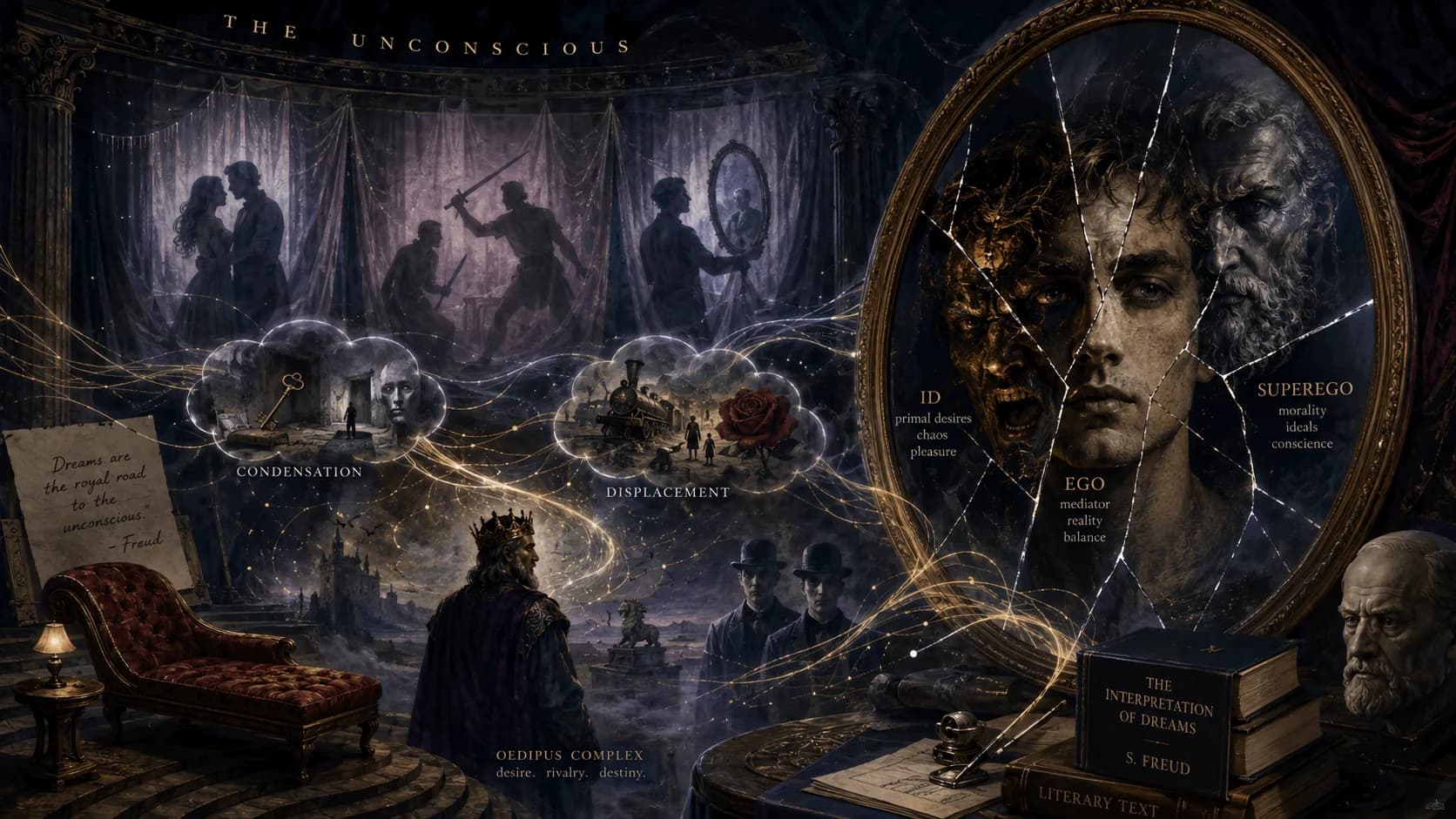
Freud's The Interpretation of Dreams (1900) argues that the dream is 'the royal road to the unconscious.' The manifest content (what the dream appears to show) disguises the latent content (the repressed wish) through two primary mechanisms: condensation (multiple ideas or images compressed into one — Freud's metaphor for metaphor) and displacement (emotional energy transferred from one idea to another — corresponding to metonymy). A third mechanism, secondary revision, imposes narrative coherence on the dream material. Applied to literary criticism: the literary text is analogous to the dream. Its surface — plot, character, style — is the manifest content; the repressed desires and conflicts it encodes are the latent content. The critic's task is to read through the manifest to the latent — to uncover the unconscious drives that the text simultaneously expresses and disguises. Freud himself performed this in his reading of Jensen's Gradiva (1907) and in his essays on Leonardo da Vinci and Dostoevsky.
Literary & Indian Examples
Literary: In Wuthering Heights, Heathcliff's uncanny return after years of absence, the doubling of the generations, and the ghostly haunting of Cathy all encode repressed desires that the text cannot speak directly — the violence of sexual desire, the transgression of class boundaries, the death wish. A psychoanalytic reading deciphers these as the latent content of the novel's manifest Gothic machinery. Indian example: In Tagore's Ghare-Baire (The Home and the World), Nikhilesh's inability to resist Sandip's charisma and his passive acceptance of his wife's infatuation encodes a repressed homosocial desire that the novel's surface nationalist-political narrative displaces. The unconscious of the text is not the unconscious of the character but of the narrative itself.
Definition
Freud's structural model (1923) divides the psyche into the Id (instinctual drives, pleasure principle), the Ego (mediating reality principle), and the Superego (internalised moral authority). The Oedipus Complex — the child's desire for the opposite-sex parent and rivalry with the same-sex parent — is the central organising drama of psychosexual development.
Visual Model — Freud's Structural Model (1923)
Explanation
The structural model replaced Freud's earlier topographical model (conscious/preconscious/unconscious). The Id is the primitive core of the psyche — entirely unconscious, governed by the pleasure principle, seeking immediate gratification of Eros (the life/sexual drive) and Thanatos (the death drive). The Ego develops from the Id through contact with external reality; it operates on the reality principle, mediating between the Id's demands, the Superego's prohibitions, and the external world. The Superego is the internalised voice of parental and cultural authority — moral conscience, self-observation, and the ego ideal. The resolution of the Oedipus Complex installs the Superego: the child renounces the incestuous desire through castration anxiety (male) or the recognition of already being 'castrated' (female), internalises the prohibiting parent's authority, and forms an identification with the same-sex parent. Neurotic symptoms, for Freud, are compromise formations: the repressed desire manages to return in disguised form despite the Superego's prohibition. Literature, similarly, is a compromise formation: it expresses forbidden desires in aesthetically sanitised form, allowing both expression and denial.
Literary & Indian Examples
Literary: Ernest Jones reads Hamlet's delay as an Oedipal symptom: Hamlet cannot kill Claudius because Claudius has enacted Hamlet's own repressed desire (killed the father, possessed the mother). The murder of Claudius would be a form of self-punishment. The Superego's prohibition is operative — not against the killing of a usurper, but against the exposure of Hamlet's own desire. Indian example: In Anita Desai's Clear Light of Day, the relationship between Bim and Raja — her inability to forgive him for leaving, her possessive love, her identification with their neglected father — can be read as an unresolved Oedipal structure in which family dynamics substitute for the repressed desires the novel cannot state directly.
Definition
The uncanny (das Unheimliche) is the aesthetic experience of something simultaneously familiar and strange — the feeling produced when something long repressed or long familiar becomes suddenly strange, or when something that should remain hidden makes an unexpected return. It is, for Freud, the return of the repressed.
Explanation
Freud's essay 'The Uncanny' (1919) is his most extended contribution to aesthetics and one of the most cited texts in psychoanalytic literary criticism. Freud notes that the German word heimlich (homely, familiar) develops a secondary meaning of 'hidden' or 'secret' — so that its apparent opposite, unheimlich (unhomely, uncanny), turns out to be secretly continuous with it. The uncanny is not simply the frightening or the unknown; it is specifically the return of something familiar that has been made strange through repression. In literature, the uncanny manifests as: the double or doppelgänger (the protagonist's own self appearing as a threatening other — indicating the return of the repressed ego); the return of the dead (the ghost as the return of repressed grief or guilt); the automaton or mechanical figure (anxiety about the boundary between the living and the dead — castration anxiety displaced onto the fear of losing one's eyes, as in Hoffmann's Sandman); the uncanny recurrence or fateful repetition. The uncanny is closely linked to Freud's concept of the death drive: the compulsion to repeat traumatic experiences is the death drive's expression.
Literary & Indian Examples
Literary: Mary Shelley's Frankenstein is a sustained uncanny text: the creature is familiar (human in origin, human in speech and desire) yet strange (assembled from corpses, monstrous in body). The creature is Frankenstein's double — his repressed desire for omnipotence and creation returning as horror. R.L. Stevenson's The Strange Case of Dr Jekyll and Mr Hyde literalises the uncanny double: Hyde is the return of Jekyll's repressed drives in an unrecognisably distorted form. Indian example: Rabindranath Tagore's short story 'The Hungry Stones' (Kshudita Pashan) is a classic Indian uncanny text: the narrator's encounter with the deserted Mughal palace produces the uncanny experience of time collapsing, the past returning in the present, the familiar (a historical building) becoming suddenly strange and inhabited by repressed history.
Definition
Lacan's Mirror Stage describes the infant's formation of an imaginary unified self through identification with its mirror reflection — a fundamental misrecognition that constitutes the subject. His three orders — the Symbolic (language, the Law), the Imaginary (images, identifications), and the Real (that which resists symbolisation) — provide a comprehensive framework for literary and cultural analysis.
Visual Model — Mirror Stage & The Three Orders
Explanation
Lacan's 'return to Freud' via Saussurean linguistics produces a radical reformulation of psychoanalysis. The Mirror Stage (lecture 1936, published 1949): before the infant can control its body, it recognises itself in a mirror as a unified, coherent image — the Ideal-I. This identification is alienating: the self is constituted through an external image, an other, a fiction of coherence. All subsequent identifications replicate this structure — including the reader's identification with characters. The Three Orders: the Symbolic is the order of language, the Law, and the signifier — entry into the Symbolic is entry into social order, but at the cost of the subject's alienation from its own desire (which becomes the unconscious). The Imaginary is the order of dyadic identifications, images, and the ego. The Real is that which cannot be symbolised, which resists capture in language — it is not 'reality' but the impossible kernel that the Symbolic can never fully cover. The Real returns as trauma, anxiety, and the uncanny. Lacan's formula 'the unconscious is structured like a language' rewrites Freud's dream mechanisms as linguistic: condensation = metaphor (substitution along the axis of similarity); displacement = metonymy (substitution along the axis of contiguity).
Literary & Indian Examples
Literary: In Great Expectations, Pip's construction of himself — his social aspirations, his shame about Joe, his idealisation of Estella — is a sustained Mirror Stage drama: Pip constructs a Symbolic identity (the 'gentleman') through an identificatory misrecognition (Estella's contempt, Miss Havisham's manipulation). The Real returns in the revelation of Magwitch as his benefactor — the repressed origin that the Symbolic identity of 'gentleman' was constructed to deny. Indian example: In Rohinton Mistry's A Fine Balance, the characters' aspirations and self-constructions (Dina's identity as an independent widow, Maneck's nostalgia for the hills) are Lacanian mirror-stage formations — imaginary coherences that the Real of Emergency-era India repeatedly shatters.
Definition
The abject is that which must be expelled from the self to constitute a coherent identity — bodily waste, the corpse, the maternal body — but which cannot be fully expelled. It hovers at the border between self and other, subject and object, provoking a mixture of horror and fascination. Literature of abjection exploits this border condition.
Explanation
Julia Kristeva's Powers of Horror (1980) introduces abjection as the foundational process by which the subject constitutes itself. Before there can be a self, there must be a not-self — something that is expelled, cast off, designated as Other and disgusting. The abject is not an object (which has a stable position in symbolic space) but that which disturbs identity, system, and order — that which does not respect borders, positions, rules. The primary forms of the abject: bodily fluids and waste (sweat, blood, excrement — the leakage of the body that threatens its boundaries), the corpse (the most sickening form of waste, the body itself become abject, the border between self and non-self collapsed), the maternal body (the body from which the self must separate to achieve identity — the abject origin that must be repudiated). The aesthetic dimension: the literary text can approach abjection through horror (Poe, Kafka, Celine — whom Kristeva analyses at length), through the Gothic, through representations of bodily dissolution. The reader's response to abjection is not simply disgust but the vertiginous pleasure of approaching the border of their own subject-formation.
Literary & Indian Examples
Literary: Toni Morrison's Beloved is the most powerful literary text of abjection: Sethe's act of killing her daughter to prevent her re-enslavement produces a figure (the returned Beloved) who is both dead and living, both child and adult, both the murdered daughter and the accumulated trauma of the Middle Passage. Beloved is the abject — expelled (killed) but returning, disturbing the boundary between life and death, self and other, past and present. Indian example: Mahasweta Devi's 'Breast Giver' (Stanodayini) turns the nursing maternal body into the site of abjection: Jashoda's body, commodified and eventually consumed by cancer, enacts the abjection of the maternal — the body that nourishes is also the body that becomes waste, that the social order uses up and discards.
Definition
Harold Bloom's anxiety of influence describes the Oedipal struggle between a strong new poet (the ephebe) and a powerful precursor. The ephebe must 'misread' the precursor — through one of six revisionary ratios — to clear imaginative space for original creation. Literary history is the record of this creative wrestling.
Explanation
Bloom's The Anxiety of Influence (1973) applies the Oedipus complex to literary history. Every strong poet confronts the crushing weight of a strong predecessor: if they simply imitate, they are destroyed by the precursor's greatness. To become original, they must 'misread' — creatively distort, swerve from, revise, complete, or undo — the precursor. Bloom calls this 'misprision.' The six revisionary ratios are: clinamen (the swerve — the poet departs from the precursor as if correcting him); tessera (the antithetical completion — the poet appears to extend but actually undermines the precursor); kenosis (an emptying — the poet seems to humble himself, but thereby makes the precursor seem even more diminished); daemonisation (the poet opens himself to a power beyond the precursor, claiming a higher inspiration); askesis (a self-purgation in which the poet deliberately reduces his own gifts to free himself); apophrades (the return of the dead — the later poet incorporates the precursor so fully that the precursor seems to have written in anticipation of him). Bloom applies this framework to Romantic and post-Romantic poetry: Milton is the overwhelming precursor for the English Romantics; Shakespeare is the supreme anxious precursor for all subsequent writers in English.
Literary & Indian Examples
Literary: Keats's relationship to Milton in 'Hyperion' and 'The Fall of Hyperion' is a classic anxiety of influence: Keats begins in Miltonic blank verse, then abandons the poem, in 'The Fall' explicitly repudiating the Miltonic mode as too alien to his own talent — a kenosis followed by askesis. Keats cannot escape Milton by direct confrontation; he can only escape by deliberately limiting himself. Indian example: Indian English writers' relationship to canonical British literature is a collective anxiety of influence: Salman Rushdie's relationship to the English novel (Sterne, Dickens, Joyce) — his carnivalesque revision of their realism — is a sustained clinamen, a swerve that transforms the precursor tradition into something unrecognisable.
📝 5. Text Analysis: Psychoanalytic Readings
Applying psychoanalytic concepts to three major texts — naming concept and theorist in each reading.
💀 Psychoanalytic Reading
Hamlet — William Shakespeare
- →The Oedipus Complex and Hamlet's delay (Ernest Jones / Freud): Jones's reading in Hamlet and Oedipus (1949) is the founding text of psychoanalytic literary criticism. Hamlet cannot kill Claudius because Claudius has done what Hamlet himself unconsciously desired: killed King Hamlet and possessed Gertrude. To punish Claudius would be to confront and punish his own repressed Oedipal wish. His delay is the symptom of this unconscious conflict — the Superego forbids not the killing of a usurper but the acknowledgment of the desire that identification with Claudius would expose.
- →The ghost as the return of the repressed: In Freudian terms, the Ghost is the literal return of the repressed — the dead father returning to demand that the living son act out the aggression (killing Claudius) that Hamlet's Oedipal ambivalence makes impossible. The ghost hovers between the paternal law (avenge me) and the unconscious prohibition (you cannot, because you are implicated). This is the structure of the uncanny: the familiar (the father) returned as strange (the ghost), provoking both duty and horror.
- →Lacan's reading — desire and the Other: Lacan reads Hamlet differently. For Lacan, Hamlet is a tragedy of desire — but desire in the Lacanian sense: desire is always the desire of the Other. Hamlet's paralysis is not Oedipal but structural: he cannot act because he does not know what he wants, because his desire is always mediated through the Other (the Ghost, Ophelia, Gertrude). Ophelia's madness is the return of the Real — the element that cannot be accommodated in the Symbolic order of the court.
- →Freud's uncanny and the Ghost: The Ghost of Hamlet's father is a paradigmatic uncanny figure — the dead returning to the living, the familiar (the father) appearing in a strange and threatening form. The uncanny here is not merely aesthetic but structural: it is the eruption of the Real (death, the inassimilable) into the Symbolic order of Elsinore.
🔥 Psychoanalytic Reading
Jane Eyre — Charlotte Brontë
- →Bertha Mason as Jane's repressed Id: The psychoanalytic reading of Jane Eyre is inseparable from the feminist reading (Gilbert and Gubar). Bertha Mason in the attic is Jane's double — but in Freudian terms, she is the return of the repressed Id. Bertha enacts everything Jane's Ego and Superego prohibit: uncontrolled sexuality, violent rage, the refusal of domestic containment. The fire Bertha sets is the Id's revenge on the Symbolic order that has tried to contain it.
- →Rochester as the father/lover: Rochester's authority over Jane replicates the Oedipal structure — he is simultaneously the father-figure (older, powerful, controlling) and the lover. The first proposal is the Oedipal scenario in displaced form: the fantasy of possessing the father-figure is simultaneously desired and forbidden. Jane's flight from Thornfield after the revelation of Bertha is the ego's refusal to be overwhelmed by the Id's desire.
- →The uncanny at Thornfield: The strange laughter in the house, the fire in Rochester's room, Jane's premonitory dreams — all are classic Freudian uncanny markers. Thornfield is the haunted house as the psyche: the upper floors (consciousness, the social self) conceal the attic (the unconscious, the repressed). Bertha's eventual emergence is the return of the repressed made literal.
- →The resolution as sublimation: The novel's ending — Jane's marriage to the blinded, humbled Rochester — can be read as the successful sublimation of the Oedipal desire. The father-figure has been castrated (literally blinded, the classic Freudian castration symbol), the threat of the all-powerful patriarch neutralised. Jane can now marry without the full weight of the Oedipal prohibition.
🖼️ Psychoanalytic Reading
The Picture of Dorian Gray — Oscar Wilde
- →The portrait as the unconscious: Dorian Gray's portrait is the most brilliant literary figure for the Freudian unconscious: it records what consciousness represses. As Dorian lives a life of pleasure and cruelty, his conscious self remains beautiful and unchanged — the ego's defence against acknowledging its own corruption. The portrait accumulates the reality that Dorian refuses to admit to consciousness. The psychoanalytic reading is almost too obvious — yet it reveals the structural homology between the novel's central conceit and Freud's topographical model.
- →Id, Ego, and Superego: The three major characters map onto Freud's structural model: Lord Henry Wotton is the voice of the Id — witty, amoral, advocating pure pleasure; Dorian Gray is the Ego — initially mediating between pleasure and conscience, progressively surrendering to the Id; Basil Hallward is the Superego — the conscience, the moral voice, the one who loves Dorian with a love that carries the demand for accountability. Dorian's murder of Basil is the Ego's destruction of the Superego — and the portrait's final corruption is the consequence.
- →The double and the uncanny: The portrait is the uncanny double par excellence — simultaneously Dorian and not-Dorian, familiar and monstrous. Freud's analysis of the double in 'The Uncanny' directly applies: the double represents the return of the repressed — the ego ideal turned into a persecutor, the mirror of the self's crimes. The horror Dorian feels when he looks at the portrait is the horror of the uncanny: recognition of his own hidden self.
- →Sublimation and aestheticism: Lord Henry's aestheticism — 'the only way to get rid of a temptation is to yield to it' — is Freudian anti-sublimation. Freud argues that art and civilisation depend on the sublimation of the libido — the redirection of sexual energy into socially acceptable creative work. Wilde's novel suggests that pure aestheticism without sublimation (pure Id gratification without Superego mediation) leads inevitably to self-destruction.
Prof. Amirul Khan’s Exam Insight
Always specify which psychoanalytic framework you are using and why it applies to this text. Don’t just say “the unconscious” — say “Freud’s concept of repression and the return of the repressed, operating through the uncanny,” and then name the specific textual evidence. Examiners distinguish between students who know the theory and students who have merely heard the vocabulary.
⚖️6. Strengths & Limitations
✅ Strengths
- →Accesses dimensions of meaning — desire, repression, the uncanny — unavailable to purely formal approaches
- →Freud's uncanny theory is directly illuminating for Gothic, horror, and trauma literature
- →The text-as-dream analogy is genuinely productive for analysing symbolic structures and displacements
- →Lacan opens psychoanalytic criticism to language, subjectivity, and the Real — engaging with poststructuralism
- →Kristeva's abject is indispensable for analysing bodily horror, Gothic fiction, and trauma narrative
- →Bloom's anxiety of influence provides a rich model for understanding literary influence and literary history
❌ Limitations
- →Unfalsifiability — psychoanalytic claims about the unconscious cannot be empirically tested or disproved
- →Biographical fallacy — treating texts as symptoms of the author's psychology ignores aesthetic specificity
- →Eurocentrism — the Oedipus complex assumes the bourgeois nuclear family; doesn't translate across all cultures
- →Androcentric bias — female psychology defined as derivative of male; extensively criticised by feminist theorists
- →Reductionism — collapsing textual complexity into a single psychoanalytic formula (everything is Oedipal)
- →Circular interpretation — evidence for the unconscious is found in the text whose meaning it determines
🎯 7. Interactive MCQs
25 UGC NET–pattern questions — all 5 question types. Covers Freud, Lacan, Jung, and Bloom.
Psychoanalytic Criticism — UGC NET MCQs
Direct MCQFreud's topographical model of the mind divides it into:
📋 8. Exam-Oriented Questions with Answers
📌 Answers provided for self-study. Write in your own words in the actual exam.
What are Freud's two models of the mind? Name the key terms of each.
Freud proposed two models: (1) Topographical model (The Interpretation of Dreams, 1900) — Conscious, Preconscious, and Unconscious. (2) Structural model (The Ego and the Id, 1923) — Id (instinctual drives, pleasure principle), Ego (reality principle, mediating agency), and Superego (internalised moral authority). The structural model is more useful for literary criticism because it describes dynamic agency and conflict rather than mere spatial arrangement.
What is the 'Oedipus Complex' and how has it been applied to literary criticism?
The Oedipus Complex (Freud) is the child's unconscious desire for the opposite-sex parent and rivalry with the same-sex parent. Its resolution (through castration anxiety) installs the Superego. Ernest Jones applied it to Hamlet (1910/1949): Hamlet cannot kill Claudius because Claudius has fulfilled Hamlet's own Oedipal desire, making self-punishment — not simply regicide — the unconscious issue.
Define Freud's concept of 'the uncanny' (das Unheimliche).
The uncanny (Freud, 1919) is the aesthetic experience of something simultaneously familiar and strange — specifically the return of what has been repressed or made secret. The German heimlich means both 'homely/familiar' and 'hidden/secret' — unheimlich is therefore continuous with heimlich. In literature it manifests as the double, the return of the dead, the automaton, and fateful repetition.
What is Lacan's 'Mirror Stage'?
Lacan's Mirror Stage (1936/1949) describes the infant's formation of a unified, imaginary self-image through identification with its mirror reflection. This identification is alienating: the self is constituted through an external image — a fiction of coherence. All subsequent identifications, including the reader's identification with literary characters, replicate this structure of misrecognition.
Name Lacan's three orders and briefly define each.
The Symbolic: the order of language, the Law, the signifier, social norms — entry into the Symbolic is entry into culture. The Imaginary: the order of images and identifications — dyadic relations, the ego, the mirror-stage. The Real: that which resists symbolisation and cannot be captured in language — it returns as trauma, anxiety, and the uncanny.
What does Lacan mean by 'the unconscious is structured like a language'?
Lacan's formula rewrites Freud's dream mechanisms through Saussurean linguistics: condensation (multiple ideas compressed into one) corresponds to metaphor (substitution on the axis of similarity); displacement (emotional energy transferred between ideas) corresponds to metonymy (substitution on the axis of contiguity). The unconscious operates through signifiers, not drives — it is the residue of the subject's entry into the Symbolic Order.
What is Kristeva's concept of 'the abject'?
The abject (Kristeva, Powers of Horror, 1980) is that which must be expelled from the self to constitute a coherent identity — bodily fluids, the corpse, the maternal body — but which cannot be fully expelled, hovering at the border between self and other. Literature of abjection exploits this border to produce a response that mixes horror and fascination — neither pure disgust nor pure pleasure.
Explain Harold Bloom's 'anxiety of influence.'
Bloom's anxiety of influence (The Anxiety of Influence, 1973) describes the Oedipal struggle of a new poet (the ephebe) with a strong precursor. To avoid being crushed by the precursor's greatness, the ephebe must 'misread' (misprision) the precursor through one of six revisionary ratios (clinamen, tessera, kenosis, daemonisation, askesis, apophrades), distorting the precursor to clear imaginative space for original creation.
What is Freud's concept of 'sublimation' and its relevance to literary creativity?
Sublimation is the redirection of libidinal (sexual) energy from its instinctual aims toward socially valued, non-sexual goals — art, intellectual work, science. In 'Creative Writers and Day-Dreaming' (1908), Freud argues that literature is sublimated wish-fulfilment: the writer transforms private fantasies into aesthetically acceptable forms, allowing readers to vicariously enjoy forbidden desires without the guilt of direct wish-fulfilment.
What is Freud's 'condensation' and 'displacement' in dream-work and their literary equivalents?
Condensation: multiple ideas or images are compressed into a single dream element — the disguise mechanism corresponding to metaphor. Displacement: emotional charge is transferred from one idea to another, less dangerous one — corresponding to metonymy. In literary analysis: condensation explains how a single symbol (Bertha Mason) can carry multiple repressed meanings simultaneously; displacement explains how a text's surface concerns (class, ambition) are charged with displaced energy from its repressed concerns (sexual desire, violence).
What is Kristeva's distinction between the 'semiotic' and the 'symbolic'?
In Revolution in Poetic Language (1974), Kristeva distinguishes: the symbolic (grammar, syntax, structured meaning — the paternal, Oedipal register) from the semiotic (the pre-linguistic bodily register of drives, rhythms, and energies associated with the maternal — the chora). The semiotic pulses through language as rhythm, musicality, and disruption. Avant-garde and poetic language is the site where the semiotic irrupts into the symbolic.
Name Bloom's six revisionary ratios and explain any two.
The six revisionary ratios are: clinamen (the swerve — the poet departs from the precursor as if correcting an error); tessera (antithetical completion — extending the precursor to undermine him); kenosis (self-emptying — apparently humble, actually diminishing the precursor); daemonisation (claiming a higher inspiration beyond the precursor); askesis (self-purgation to reduce the precursor's influence); apophrades (the return of the dead — the poet incorporates the precursor so fully that the precursor seems to anticipate him). Clinamen: Milton swerves from Spenser by subliming his pastoral; apophrades: Keats in the odes seems to make Spenser and Milton appear to have written in anticipation of him.
What is the difference between Freud's and Jung's concept of the unconscious?
Freud's unconscious is primarily personal: it contains each individual's repressed experiences, wishes, and memories — material unique to the individual's psychosexual history. Jung's collective unconscious is trans-personal: beneath the personal unconscious lies a layer shared by all humanity, expressing itself through archetypes — universal patterns (the Hero, the Great Mother, the Shadow, the Anima/Animus) that recur across cultures and literatures.
What is 'repetition compulsion' (Wiederholungszwang) in Freud?
Repetition compulsion (Freud, Beyond the Pleasure Principle, 1920) is the tendency to repeat traumatic experiences — apparently against the pleasure principle. Freud links it to the death drive (Thanatos): the organism's fundamental tendency to return to an earlier, inorganic state. In literary analysis: repetition compulsion explains the narrative structure of trauma fiction, the return of repressed material in Gothic fiction, and the uncanny experience of déjà vu and fateful repetition.
How does Fredric Jameson's 'political unconscious' adapt psychoanalysis to Marxist literary criticism?
Jameson's The Political Unconscious (1981) applies the psychoanalytic model to the collective level: ideology represses contradictions in the social formation just as repression functions in the individual psyche. Literature encodes these repressed social contradictions in its form and content — the literary text's manifest content disguises the latent content of class conflict, historical contradiction, and utopian desire. Literary criticism's task is to read through the manifest to the political unconscious — the repressed history that the text simultaneously expresses and conceals.
Explain Ernest Jones's psychoanalytic reading of Hamlet. How does it apply the Oedipus complex to explain Hamlet's delay?
✍️ Model Answer
Explain Lacan's three orders — Symbolic, Imaginary, and Real — and their application to literary criticism.
✍️ Model Answer
What is Kristeva's theory of the abject? Apply it to a specific literary text.
✍️ Model Answer
Explain Bloom's 'anxiety of influence.' Illustrate with a specific example from literary history.
✍️ Model Answer
What are the major strengths and limitations of psychoanalytic literary criticism?
✍️ Model Answer
❓ 9. Frequently Asked Questions
Q1. What is psychoanalytic literary criticism?
Psychoanalytic literary criticism applies the concepts and frameworks of psychoanalysis — developed by Freud and significantly reformulated by Lacan, Jung, and others — to the interpretation of literary texts. It reads literary texts as analogous to dreams: their surface (manifest content — plot, character, style) disguises a latent content of repressed desires, fears, and conflicts. Psychoanalytic criticism may focus on the psychology of the fictional characters (reading them as if they were patients), on the psychology of the author (reading the text as an expression of the author's unconscious), or on the reader (analysing the psychological effects of the text on the reader's unconscious). More sophisticated approaches (following Lacan) analyse the textual unconscious itself — the ways the text's formal structures, gaps, repetitions, and contradictions encode psychic processes.
Q2. What is Freud's 'topographical' model and how does it differ from the 'structural' model?
Freud proposed two successive models of the mind. The topographical model (The Interpretation of Dreams, 1900) divides the psyche into three systems: the Unconscious (repressed material inaccessible to awareness), the Preconscious (material available to awareness with effort), and the Conscious (what we are directly aware of). The structural model (The Ego and the Id, 1923) replaced this with three agencies: the Id (instinctual drives, entirely unconscious, governed by the pleasure principle), the Ego (the mediating agency, partly conscious and partly unconscious, governed by the reality principle), and the Superego (the internalised moral authority, partly conscious, derived from the resolution of the Oedipus complex). The structural model is more useful for literary criticism because it describes dynamic conflict rather than mere topology.
Q3. How does Lacan's psychoanalysis differ from Freud's?
Lacan's 'return to Freud' is simultaneously a radical reformulation. Three key differences: (1) Language: Lacan rewrites Freud's dream mechanisms (condensation, displacement) through Saussurean linguistics — condensation becomes metaphor, displacement becomes metonymy. The unconscious is structured like a language. (2) The subject: Freud's ego is a relatively stable mediating agency; for Lacan, the subject is split, constituted through alienation in the Mirror Stage and through entry into the Symbolic Order. There is no unified self — only a subject constituted through a fundamental misrecognition. (3) The three orders: Lacan's Symbolic/Imaginary/Real replaces Freud's topographical or structural models with a more complex account of how language, image, and the unrepresentable Real interact in the constitution of the subject.
Q4. What is Freud's concept of sublimation and how does it relate to artistic creation?
Sublimation is Freud's term for the psychic mechanism by which sexual energy (the libido) is redirected from its original sexual aims toward socially valued, non-sexual goals — art, intellectual work, religious devotion. In 'Creative Writers and Day-Dreaming' (1908), Freud argues that the artist is essentially a daydreamer who has learned to make socially acceptable and aesthetically pleasing the private fantasies that in others remain shameful or neurotic. The literary text is a compromise formation: it expresses forbidden desires (Id) in aesthetically disguised form that allows the reader to enjoy the fantasy without the guilt (Superego) that would ordinarily accompany it. This is Freud's explanation of the pleasure of fiction: readers can vicariously gratify unconscious wishes through the text without repression.
Q5. What are Jung's archetypes and how do they differ from Freud's approach?
C.G. Jung broke from Freud to develop his own analytical psychology. The key difference: Freud's unconscious is primarily personal — the repository of each individual's repressed experiences. Jung posits a collective unconscious beneath the personal unconscious — a shared psychic substrate common to all humanity, expressing itself through archetypes: universal, inherited patterns of psychic experience (the Great Mother, the Wise Old Man, the Hero, the Shadow, the Anima/Animus, the Self). For literary criticism, Jungian archetypes provide a framework for identifying universal mythic patterns in literature — the hero's journey, the descent into the underworld, the death-and-rebirth cycle. This overlaps with Northrop Frye's archetypal criticism but is rooted in depth psychology rather than structural literary theory.
Q6. What is Kristeva's distinction between the 'semiotic' and the 'symbolic'?
In Revolution in Poetic Language (1974), Kristeva distinguishes the semiotic from the symbolic. The symbolic is the order of grammar, syntax, and meaning — structured, rule-governed language. The semiotic is the pre-linguistic, pre-Oedipal bodily register — the drives, rhythms, intonations, and energies that persist within language from the earliest stage of psychic life (associated with the maternal body). The semiotic does not disappear with entry into language; it continues to pulse through language as rhythm, musicality, non-sense, and disruption. Poetic language — especially avant-garde poetry (Mallarmé, Artaud) — is the site where the semiotic irrupts into the symbolic, disrupting its grammar and meaning-structures. This is the 'revolution' of the title: the semiotic has a potentially radical, destabilising political force.
Q7. What are the major criticisms of psychoanalytic literary criticism?
Psychoanalytic literary criticism faces several serious objections: (1) Empirical untestability — psychoanalytic claims about the unconscious cannot be verified or falsified by empirical methods; this makes psychoanalytic readings interpretively circular (the evidence for the unconscious wish is found in the text, but the text's meaning is determined by the hypothesis of the unconscious wish). (2) Biographical fallacy — the 'author's unconscious' approach reduces texts to symptoms of the author's psychology, ignoring their aesthetic and historical specificity. (3) Universalism — Freud's Oedipus complex claims universal validity but reflects the specific bourgeois European family structure of the late 19th century. (4) Gender bias — Freudian theory is notoriously androcentric: the female is defined as the castrated male, her psychology as derivative. Feminist critics (Horney, Mitchell, Irigaray) have extensively criticised this. (5) Reductionism — the text may be reduced to a symptom, its richness collapsed into a single psychoanalytic formula.
Q8. How is psychoanalytic criticism examined in UGC NET English?
UGC NET English tests psychoanalytic criticism at several levels: (1) Key concepts and their authors — Freud/unconscious/Oedipus complex/uncanny/sublimation, Lacan/Mirror Stage/Symbolic-Imaginary-Real/the unconscious structured like a language, Kristeva/abject/semiotic-symbolic, Bloom/anxiety of influence/six revisionary ratios. (2) Key texts and dates — The Interpretation of Dreams (1900), 'The Uncanny' (1919), The Ego and the Id (1923), Jones's Hamlet and Oedipus (1949), Lacan's Écrits (1966), Bloom's Anxiety of Influence (1973), Kristeva's Powers of Horror (1980). (3) Application to canonical texts — Hamlet (Jones's reading), Jane Eyre (Bertha as double), Dorian Gray (portrait as unconscious). (4) Distinction between Freudian and Lacanian approaches. (5) Connections to other theories — feminist psychoanalysis (Mitchell, Irigaray), psychoanalytic Marxism (Jameson).
📋 10. Quick Reference — Exam Cheat Sheet
Prof. Amirul Khan — amirulkhan.in
Psychoanalytic Criticism — Quick Reference Cheat Sheet
Key Thinkers
Sigmund Freud (1856–1939)
Founder of psychoanalysis — unconscious, Oedipus complex, dream-work, repression, sublimation, uncanny
C.G. Jung (1875–1961)
Analytical psychology — collective unconscious, archetypes, anima/animus, Shadow, individuation
Ernest Jones (1879–1958)
First major psychoanalytic literary reading — Hamlet's delay as Oedipal paralysis
Jacques Lacan (1901–1981)
Return to Freud via Saussure — Mirror Stage, Symbolic/Imaginary/Real, the unconscious structured like a language
Harold Bloom (1930–2019)
Anxiety of influence — Oedipal struggle between poets; six revisionary ratios (clinamen, tessera, etc.)
Julia Kristeva (1941–)
The abject — the expelled border between self and other; semiotic vs symbolic; Powers of Horror
Fredric Jameson (1934–2024)
The political unconscious — ideology as repressed history; Marxist psychoanalytic literary criticism
Key Concepts
💭 The Unconscious & Dream-Work
The unconscious is the repository of repressed desires, fears, and memories — inaccessible to direct awareness but constantly pressing for expression in disguised forms: dreams, slips of the tongue (parapraxes), symptoms, and — crucially for literary criticism — art and literature.
⚖️ Id, Ego, Superego & the Oedipus Complex
Freud's structural model (1923) divides the psyche into the Id (instinctual drives, pleasure principle), the Ego (mediating reality principle), and the Superego (internalised moral authority). The Oedipus Complex — the child's desire for the opposite-sex parent and rivalry with the same-sex parent — is the central organising drama of psychosexual development.
👁️ The Uncanny (Das Unheimliche)
The uncanny (das Unheimliche) is the aesthetic experience of something simultaneously familiar and strange — the feeling produced when something long repressed or long familiar becomes suddenly strange, or when something that should remain hidden makes an unexpected return. It is, for Freud, the return of the repressed.
🪞 Lacan: Mirror Stage & the Three Orders
Lacan's Mirror Stage describes the infant's formation of an imaginary unified self through identification with its mirror reflection — a fundamental misrecognition that constitutes the subject. His three orders — the Symbolic (language, the Law), the Imaginary (images, identifications), and the Real (that which resists symbolisation) — provide a comprehensive framework for literary and cultural analysis.
🩸 The Abject (Kristeva)
The abject is that which must be expelled from the self to constitute a coherent identity — bodily waste, the corpse, the maternal body — but which cannot be fully expelled. It hovers at the border between self and other, subject and object, provoking a mixture of horror and fascination. Literature of abjection exploits this border condition.
⚔️ Anxiety of Influence (Bloom)
Harold Bloom's anxiety of influence describes the Oedipal struggle between a strong new poet (the ephebe) and a powerful precursor. The ephebe must 'misread' the precursor — through one of six revisionary ratios — to clear imaginative space for original creation. Literary history is the record of this creative wrestling.
🌙 11. Night-Before-Exam Traps
Ten commonly confused Psychoanalytic Criticism pairs — guess each one, then reveal.
The PDF includes every answer and explanation, even ones you haven't revealed here.
Trap 1 — Id seeks PLEASURE, Superego enforces MORALITY
Which term does this describe?
The primitive, entirely unconscious part of the psyche that seeks immediate gratification and operates on the pleasure principle is Freud's ___.
✅ Correct
- Id
❌ The trap most students write
Superego
The Superego is the internalised voice of parental and cultural authority — moral conscience — restraining rather than seeking gratification. The Ego develops from the Id and mediates between the Id's demands and the Superego's prohibitions via the reality principle.
Trap 2 — Manifest content is what you SEE, Latent is what's HIDDEN
Which term does this describe?
In Freud's dream theory, the disguised surface content of a dream — what it appears to show — is called the ___ content, concealing the repressed wish beneath it.
✅ Correct
- Manifest
❌ The trap most students write
Latent
Latent content is the repressed wish itself, hidden beneath the dream's surface. Manifest content is what the dreamer actually experiences and reports — the disguise, not the truth underneath it.
Trap 3 — Condensation COMPRESSES, Displacement TRANSFERS
Which term does this describe?
The dream-work mechanism in which multiple ideas or images are compressed into a single symbol — corresponding to metaphor — is Freud's ___.
✅ Correct
- Condensation
❌ The trap most students write
Displacement
Displacement is the other mechanism — transferring emotional energy from one idea onto another, corresponding to metonymy. Lacan later mapped condensation onto metaphor and displacement onto metonymy, a frequently tested pairing.
Trap 4 — Heimlich secretly ALSO means 'hidden'
Which meaning completes Freud's philological point?
Freud's key discovery in 'The Uncanny' is that the German word for 'homely/familiar' (heimlich) develops a secondary meaning of ___ — making it secretly continuous with its apparent opposite, unheimlich.
✅ Correct
- Hidden or secret
❌ The trap most students write
Foreign or unknown
The uncanny's power comes precisely from this hidden continuity — heimlich already contains 'hidden' within itself, so unheimlich is not simply 'unfamiliar' but the return of something familiar-yet-repressed. Students often assume unheimlich just means 'unknown,' missing Freud's actual philological point.
Trap 5 — The Symbolic is LANGUAGE and LAW, not images
Which Lacanian order does this describe?
In Lacan's three orders, the register of language, the Law, and the signifier — entry into which alienates the subject from its own desire — is the ___.
✅ Correct
- Symbolic
❌ The trap most students write
Imaginary
The Imaginary is the order of images, dyadic identifications, and the ego, rooted in the Mirror Stage. The Symbolic is specifically language and law. The Real is the third order — what resists symbolisation altogether and returns as trauma.
Trap 6 — The Real resists SYMBOLISATION, it isn't just 'reality'
Which Lacanian order does this describe?
The Lacanian order that cannot be captured in language and returns as trauma, anxiety, and the uncanny is the ___ — not to be confused with ordinary 'reality.'
✅ Correct
- Real
❌ The trap most students write
Symbolic
Despite its name, the Real is not 'reality' in the everyday sense — it is the impossible kernel that the Symbolic order can never fully cover or express. The Symbolic, by contrast, is the order of language and law that structures social existence.
Trap 7 — The Mirror Stage is a MISRECOGNITION
Which term completes Lacan's claim?
Lacan's Mirror Stage describes the infant's identification with its coherent mirror reflection as a fundamental ___ that nonetheless constitutes the subject.
✅ Correct
- Misrecognition
❌ The trap most students write
Accurate self-perception
The infant cannot yet control its body, so the coherent, unified image in the mirror is a fiction — an external image mistaken for the self. This alienating misrecognition (not accurate self-knowledge) is what Lacan argues founds all subsequent identification, including a reader's identification with characters.
Trap 8 — The Abject is neither SUBJECT nor OBJECT
Which term completes Kristeva's definition?
Kristeva's term for bodily waste, the corpse, or the maternal body — which must be expelled to form identity but can never be fully expelled — describes something that is neither subject nor ___, but disturbs the border between the two.
✅ Correct
- Object
❌ The trap most students write
Other
Kristeva is precise: the abject is not simply 'the Other' in a general sense (a stable category) — it specifically disturbs the very distinction between subject and object, self and non-self, refusing to occupy either stable position.
Trap 9 — Clinamen is the SWERVE, Apophrades is the RETURN OF THE DEAD
Which revisionary ratio does this describe?
In Bloom's six revisionary ratios, the term for a poet's initial swerve away from the precursor — as if correcting him — is ___.
✅ Correct
- Clinamen
❌ The trap most students write
Apophrades
Apophrades ('the return of the dead') is the final ratio, where the later poet absorbs the precursor so completely that the precursor seems to have written in anticipation of the later poet. Clinamen is the first ratio, the initial swerve — the six ratios have a specific sequence that exams test directly.
Trap 10 — The Ego develops FROM the Id, not the reverse
Which term completes Freud's structural model?
Freud's structural model holds that the ___ develops out of the Id through contact with external reality, mediating between the Id's demands and the Superego's prohibitions.
✅ Correct
- Ego
❌ The trap most students write
Superego
The Ego operates on the reality principle and develops from the Id specifically through contact with the external world. The Superego, by contrast, is installed later, through resolution of the Oedipus complex, as the internalised voice of parental authority — a separate developmental step.
📚 Related Study Resources
Reader-Response Theory
Iser's gaps, Fish's interpretive communities, Jauss's horizon of expectations.
Read →Poststructuralism & Deconstruction
Derrida's différance, Barthes's Death of the Author, Foucault's discourse.
Read →Feminist Literary Theory
Gynocriticism, écriture féminine, Butler's gender performativity, intersectionality.
Read →Postcolonialism
Said's Orientalism, Bhabha's Hybridity, Spivak's Subaltern — with MCQs.
Read →Archetypal Criticism
Jung's archetypes, Frye's Four Mythoi, Campbell's Hero's Journey.
Read →Queer Theory
Butler's performativity, Sedgwick's epistemology of the closet — psychoanalysis underpins both Sedgwick and Butler.
Read →Prof. Amirul Khan
English Literature & Competitive Exam Expert
Dedicated to making literary theory accessible for BA, MA, and UGC NET aspirants. These notes synthesise Psychoanalytic Criticism — from Freud through Lacan and Kristeva — with rigorous attention to exam patterns, textual application, and the Indian literary context.
Master every theory, trap, and question type for UGC NET English.
Explore our full library of literary theory notes, grammar traps, MCQ sets, and mock tests — all crafted to the exact UGC NET exam format.
Covering UGC NET · BA · MA · SSC CGL · State PSC English
🔒 Protected Content — This analysis is original work, © Prof. Amirul Khan, All Rights Reserved. You're welcome to read, cite, and quote it with attribution and a link back — but full republication elsewhere isn't permitted. See our Licensing Policy for details.