Feminist Literary Theory: Gender, Power & the Female Voice
Complete notes covering Woolf’s material feminism, de Beauvoir’s Second Sex, Showalter’s gynocriticism, Cixous’s écriture féminine, Gilbert & Gubar’s Madwoman in the Attic, Butler’s gender performativity, and intersectionality — with timeline, text analysis, interactive MCQs, and exam questions for BA / MA / UGC NET English.
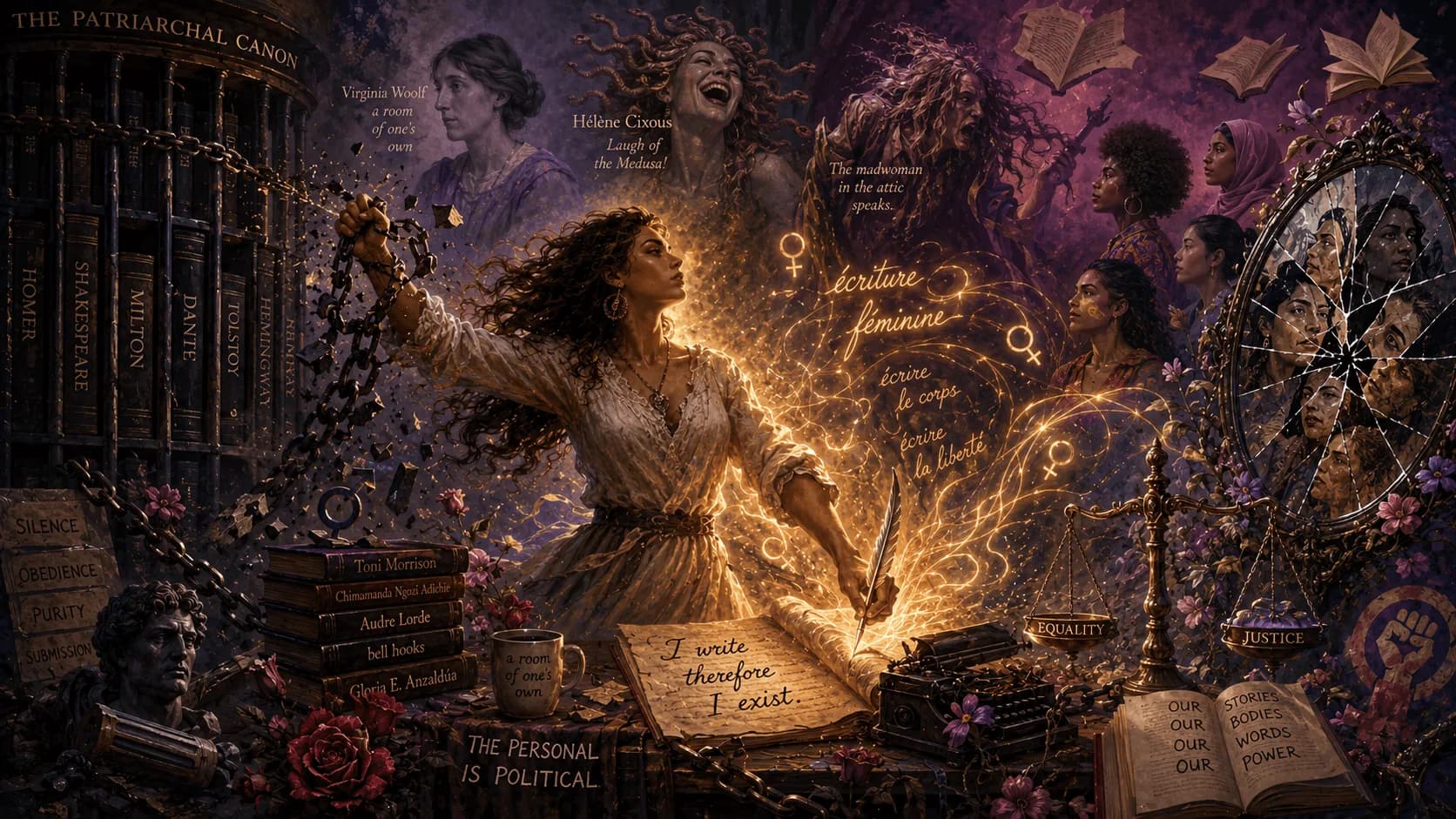
🗓️ 1. Timeline of Feminist Literary Theory
| Year | Key Development | Thinker / Work |
|---|---|---|
| 1792 | A Vindication of the Rights of Woman — first feminist manifesto | Mary Wollstonecraft |
| 1848 | Seneca Falls Convention — first women's rights convention in the US | First Wave Politics |
| 1929 | A Room of One's Own — material conditions for women's writing | Virginia Woolf |
| 1949 | The Second Sex — 'One is not born, but becomes, a woman' | Simone de Beauvoir |
| 1963 | The Feminine Mystique — naming the 'problem that has no name' | Betty Friedan |
| 1970 | Sexual Politics — patriarchy as a political system in literature | Kate Millett |
| 1975 | 'The Laugh of the Medusa' — écriture féminine manifesto | Hélène Cixous |
| 1977 | A Literature of Their Own — three phases of women's writing | Elaine Showalter |
| 1979 | The Madwoman in the Attic — the female double and anxiety of authorship | Gilbert & Gubar |
| 1984 | Feminist Theory: From Margin to Center — intersectionality and race | bell hooks |
| 1989 | 'Demarginalizing the Intersection of Race and Sex' — intersectionality coined | Kimberlé Crenshaw |
| 1990 | Gender Trouble — gender as performance, not essence | Judith Butler |
👤2. Major Thinkers: Lifespan & Contributions
| Thinker | Lifespan | Contribution | Key Work |
|---|---|---|---|
| Mary Wollstonecraft | 1759–1797 | First systematic feminist argument; reason and rights equally applicable to women | A Vindication of the Rights of Woman (1792) |
| Virginia Woolf | 1882–1941 | Material conditions for women's creativity; androgynous mind ideal | A Room of One's Own (1929) |
| Simone de Beauvoir | 1908–1986 | 'Woman' as social construction; Woman as Other to Man's Subject | The Second Sex (1949) |
| Kate Millett | 1934–2017 | Patriarchy as political system embedded in literature and culture | Sexual Politics (1970) |
| Hélène Cixous | 1937– | Écriture féminine — writing through the body as feminist resistance | 'The Laugh of the Medusa' (1975) |
| Elaine Showalter | 1941– | Gynocriticism — female literary tradition; three phases of women's writing | A Literature of Their Own (1977) |
| Sandra Gilbert & Susan Gubar | 1936– / 1944– | Anxiety of authorship; madwoman as female double encoding rage | The Madwoman in the Attic (1979) |
| bell hooks | 1952–2021 | Race, class, and gender as interlocking systems; margin as site of resistance | Feminist Theory: From Margin to Center (1984) |
| Judith Butler | 1956– | Gender performativity — gender as repeated acts, not biological essence | Gender Trouble (1990) |
🔮 3. What is Feminist Literary Theory?
Feminist literary theory is a critical approach that analyses how literature reflects, constructs, and challenges the gendered power structures of society. It asks: How are women represented in texts written by men? What female literary tradition has been suppressed by the patriarchal canon? How does language itself encode gender hierarchy? And how have women writers worked within and against these constraints?
Feminist criticism is not a single unified method but a field of competing and evolving approaches — from liberal feminism’s focus on equal representation, to radical feminism’s analysis of patriarchy as a total system, to French feminism’s engagement with language and the body, to intersectional feminism’s insistence on race, class, and sexuality as irreducible axes of analysis.
Exam-Ready Definition
Feminist literary theory is a critical practice that analyses the relationship between gender and literary production — examining how patriarchal ideology is embedded in canonical texts, recovering suppressed female literary traditions, and theorising the relationship between gender, language, and power in literature and culture.
📖 Anglo-American
Focus on women as readers and writers — images of women criticism, gynocriticism, recovery of female tradition (Woolf, Showalter, Gilbert & Gubar)
✍️ French Feminist
Focus on language, the body, and the unconscious — écriture féminine, the semiotic (Cixous, Kristeva, Irigaray)
🔀 Intersectional
Focus on race, class, sexuality, and caste as overlapping systems — Black feminist criticism, postcolonial feminism (bell hooks, Crenshaw, Spivak)
Visual Model — The Three Waves of Feminism
🧩 4. Key Concepts in Feminist Literary Theory
Six essential concepts — with definitions, full explanations, and literary & Indian examples.
Definition
Patriarchy is the systematic political and social dominance of men over women — not a natural arrangement but a structure of power that is institutionalised through law, culture, religion, education, and literature.
Visual Model — Patriarchy as a Political System
Explanation
Kate Millett's Sexual Politics (1970) was the first major work to apply the term 'patriarchy' systematically to literary and cultural analysis. Millett argued that the personal is political: sexual relationships are always already power relationships, shaped by the broader structure of male domination. She demonstrated this through close readings of Henry Miller, Norman Mailer, and D.H. Lawrence, showing how their fiction eroticises and naturalises male dominance — presenting it not as a historical and contingent arrangement but as the expression of natural, biological difference. Feminist literary criticism begins with this insight: literature does not merely reflect the world but actively constructs and normalises the gendered power structures within it.
Literary & Indian Examples
Literary: In Thomas Hardy's Tess of the d'Urbervilles, the social and legal system that destroys Tess is a patriarchal system — her 'fall' is judged by male standards of honour while Angel and Alec face no comparable judgment. Indian example: The dowry system and honour killing in Indian society are expressions of patriarchal structures that feminist critics connect to the literature that represents and normalises them — from mythology (Sita's agni-pariksha) to contemporary fiction.
Definition
Gynocriticism is the study of women as writers — the history, themes, genres, and structures of women's literature — as opposed to the study of women as readers of male-authored texts.
Explanation
Showalter coined 'gynocriticism' to describe a feminist criticism that did not define itself entirely in relation to male literature. Rather than simply critiquing how male authors represent women, gynocriticism proposes to construct a female framework for the analysis of women's literature. It studies the female literary tradition on its own terms — tracing the development of women's writing, identifying recurring themes (confinement, silence, the body, community), and recovering forgotten women writers. Showalter's three phases of women's writing provide the historical framework: Feminine Phase (1840–1880) — imitation of male standards; Feminist Phase (1880–1920) — protest and advocacy; Female Phase (1920–present) — assertion of a distinct female identity and tradition.
Literary & Indian Examples
Literary: Showalter recovers and reassesses figures like George Eliot, Elizabeth Gaskell, and Charlotte Brontë not as isolated 'great exceptions' but as participants in a continuous female literary tradition. Indian example: Gynocriticism applied to Indian literature recovers and reassesses women writers like Mahasweta Devi, Kamala Das, and Ismat Chughtai — not as exceptions to a male tradition but as part of a distinct tradition of women's writing in Indian languages.
Definition
Écriture féminine ('feminine writing') is Hélène Cixous's term for a distinctively feminine mode of writing that is rooted in the female body, fluid and non-linear in structure, and resistant to the binary, hierarchical logic of masculine (logocentric) language.
Explanation
In 'The Laugh of the Medusa' (1975), Cixous argues that Western thought is structured by binary oppositions — man/woman, reason/emotion, activity/passivity, culture/nature — in which the first term is always privileged and masculine, the second devalued and feminine. Masculine writing (associated with the Logos, reason, linearity, closure) reinforces this hierarchy. Écriture féminine subverts it: it is writing that flows from the body, embraces multiplicity, disrupts fixed meanings, and refuses the economy of ownership and closure. Cixous famously calls on women to 'write themselves' — to write their bodies into language as an act of political and psychological liberation. Her own writing (The Newly Born Woman, Stigmata) enacts écriture féminine rather than merely describing it — poetic, fragmented, associative.
Literary & Indian Examples
Literary: Virginia Woolf's The Waves and Mrs Dalloway — with their stream of consciousness, fluid time, and refusal of linear plot — can be read as precursors of écriture féminine. Indian example: Kamala Das's confessional poetry ('My Story', 'An Introduction') writes the female body, desire, and anger into a literary language that had systematically excluded them — a powerful Indian instance of écriture féminine in practice.
Definition
The 'Madwoman in the Attic' is Gilbert and Gubar's term for the monstrous or transgressive female double who appears throughout 19th-century women's fiction — a figure who encodes the female author's own rage, anxiety, and desire for freedom that could not be expressed directly.
Explanation
In their landmark study The Madwoman in the Attic (1979), Gilbert and Gubar argue that 19th-century women writers faced a fundamental problem: patriarchal literary culture defined authorship as male (the pen as 'metaphorical penis') and prescribed for women the ideal of the 'Angel in the House' — the perfectly submissive, self-effacing, domestic woman. Women writers could neither accept this role nor reject it openly without social and professional destruction. Their solution was to split the female character: the 'Angel' on the surface (Jane Eyre, the docile narrator) and the 'Madwoman' in the margins (Bertha Mason, Bertha's fire, Jane's rage). The madwoman enacts what the angel cannot feel — fury, desire, rebellion. Gilbert and Gubar extend this reading across Austen, Brontë, Eliot, Dickinson, and others, showing a hidden network of female anger encoded in the 'safe' texts of respectable Victorian women. Their companion concept is the 'anxiety of authorship' — where Harold Bloom diagnosed male writers' 'anxiety of influence' (struggle with literary fathers), women writers faced a deeper challenge: the very right to write was under question.
Literary & Indian Examples
Literary: In Jane Eyre, Bertha Mason is the madwoman literally imprisoned in the attic of Thornfield Hall. Gilbert and Gubar read her as Jane's double — enacting the rage, sexuality, and defiance that Jane herself cannot express within the constraints of Victorian femininity. Bertha burns Jane's wedding veil; she ultimately sets Thornfield ablaze. She is the destructive energy that the narrative cannot contain. Indian example: The figure of the possessed or mad woman in Indian literature — from Tagore's women to Mahasweta Devi's tribal characters — can be read through this framework as encoding female resistance to patriarchal constraint.
Definition
Gender performativity is Judith Butler's theory that gender is not a natural, pre-existing essence expressed through behaviour, but is constituted through a regulated series of repeated performances — there is no 'real' gender behind the performance; the performance produces the effect of gender.
Explanation
In Gender Trouble (1990), Butler challenges the foundational assumption of feminist theory: the sex/gender distinction. Feminism had argued that while biological sex is given, gender (the cultural meanings assigned to sex) is constructed and therefore changeable. Butler goes further: she argues that even 'biological sex' is a cultural interpretation, not a natural fact. Gender is performative — not a performance chosen by a pre-existing subject, but a set of repeated, socially regulated acts that produce the subject. The illusion of a stable, 'natural' gender identity is the effect of the repetition, not its cause. This is a political insight: if gender is produced through repetition, it can be disrupted, subverted, or parodied through alternative repetitions. Drag, for Butler, is a paradigmatic example of gender parody that exposes the constructed, imitative nature of all gender performances. Butler's theory has been enormously influential in queer theory and has complicated the feminist commitment to a stable category of 'woman' as the subject of feminist politics.
Literary & Indian Examples
Literary: Virginia Woolf's Orlando — in which the protagonist changes sex over three centuries — reads as a brilliant literary anticipation of Butler's theory. Gender in Orlando is not fixed by biology but is performed differently across different historical periods and social contexts. Indian example: The hijra community in South Asia performs a gender identity that falls outside the binary of male/female, enacting Butler's argument that the binary itself is a regulatory fiction, not a natural order.
Definition
Intersectionality describes how multiple systems of oppression — race, class, gender, sexuality, caste, disability — overlap and interact to produce experiences of discrimination that cannot be understood through any single axis alone.
Explanation
Kimberlé Crenshaw coined 'intersectionality' in her 1989 paper 'Demarginalizing the Intersection of Race and Sex,' arguing that Black women's experience of discrimination is not simply the addition of racial discrimination and gender discrimination but a distinct experience produced by their intersection. Legal frameworks and feminist theory that addressed race and gender separately failed Black women precisely because they occupied the intersection. bell hooks had developed a related argument in Feminist Theory: From Margin to Center (1984), insisting that mainstream (white, middle-class) feminism had systematically ignored the experiences of women of colour and working-class women. Intersectional feminist literary criticism asks: whose experience does this text centre? Whose does it erase? How do race, class, and gender interact in the construction of the female characters? It is the essential corrective to a feminism that speaks of 'women' as if they were a homogeneous group.
Literary & Indian Examples
Literary: Toni Morrison's Beloved and The Bluest Eye explore the intersection of race, gender, and class — the experience of Black women cannot be understood through gender alone or race alone but through their devastating intersection. Indian example: Dalit feminist criticism examines how caste and gender intersect in Indian literature — Bama's Karukku and Urmila Pawar's The Weave of My Life explore experiences that mainstream (upper-caste) feminism in India had largely ignored.
📝 5. Text Analysis: Feminist Readings
Detailed feminist analysis of three major texts — connecting textual evidence to named concepts and thinkers.
🔥 Feminist Reading
Jane Eyre — Charlotte Brontë
- →The Angel and the Madwoman: Gilbert and Gubar's central reading of the novel. Jane occupies the position of the 'Angel' — constrained, controlled, seeking love within patriarchal structures. Bertha Mason, imprisoned in the attic, is Jane's dark double — enacting the rage, sexuality, and anarchic energy that Jane cannot directly express. When Bertha burns Thornfield, she liberates Jane from her imprisonment.
- →Patriarchy and the marriage plot: Every significant relationship in the novel is structured by patriarchal power — Rochester's authority, St. John Rivers's chilling control, Brocklehurst's sadistic governance of Lowood. Jane's famous declaration 'I am no bird; and no net ensnares me' is a direct feminist assertion of self-sovereignty within a text that ends with conventional marriage — the tension is never fully resolved.
- →Postcolonial intersectionality: Spivak's reading of Jane Eyre in 'Three Women's Texts and a Critique of Imperialism' argues that Jane's feminist self-development is achieved at the expense of Bertha — a Creole woman whose madness and destruction serve as the necessary sacrifice for Jane's liberation. This intersectional critique reveals the limits of first-wave feminist readings that ignore race and empire.
- →Gynocriticism and female tradition: Showalter reads Jane Eyre as a watershed text in the female literary tradition — the first major English novel to take seriously the inner life, rage, and desire for autonomy of an ordinary woman. Charlotte Brontë's choice of a plain, poor governess as protagonist is itself a feminist act.
🚪 Feminist Reading
A Room of One's Own — Virginia Woolf
- →The material conditions of creativity: Woolf's central argument is that great literature requires material freedom — money (£500 a year) and physical space (a room of one's own). The essay demonstrates through thought experiment (the fictional Judith Shakespeare) and historical evidence that women's exclusion from literary tradition is not a reflection of inferior talent but of systematic material deprivation.
- →The androgynous mind: Woolf proposes that the greatest writers — Shakespeare, Keats, Sterne — possessed an 'androgynous mind' that could hold masculine and feminine impulses in creative tension. A purely masculine or purely feminine mind is artistically limited. This concept anticipates later feminist debates about essentialism versus constructionism.
- →The Beadle and the locked library: The famous scene in which Woolf is turned away from the Oxbridge library (women not admitted without a male fellow's escort) is a perfect image of patriarchal gatekeeping — the institutional structures that physically and legally prevented women from accessing the cultural resources necessary for literary production.
- →Feminist criticism of male tradition: Woolf's analysis of the women characters in male-authored fiction — important, brilliant, varied in imagination and yet 'insignificant in fact' — anticipates Millett's systematic critique. Men's books were full of extraordinary women; the historical record showed almost none. This gap between literary representation and historical reality is one of feminist criticism's central questions.
🌺 Feminist Reading
The God of Small Things — Arundhati Roy
- →Patriarchy and the 'Love Laws': The 'Love Laws' — the laws that dictate who should be loved, and how, and how much — represent the intersection of patriarchal, caste, and class structures in postcolonial India. Ammu's transgression (loving Velutha across the caste divide) is punished with total destruction because it violates both gender and caste hierarchies simultaneously.
- →The female body under patriarchy: Ammu's body is the site of patriarchal control throughout the novel — in her abusive marriage, in the social ostracism following her divorce, in the destruction of her relationship with Velutha. Roy gives Ammu desire, agency, and interiority that the patriarchal social order denies her, making the novel a feminist text at its core.
- →Intersectionality in Indian context: The novel perfectly demonstrates intersectional analysis — Ammu's suffering is not reducible to gender alone or caste alone, but to their specific intersection in Kerala's social hierarchy. Rahel and Estha's fates are shaped by the overlapping systems of gender, caste, class, and colonial history.
- →Women's silence and voice: The novel's non-linear, fragmented narrative structure — which circles, backtracks, and refuses the sequential logic of the patriarchal plot — can be read (following Cixous) as a formal expression of women's resistance to the linear, masculine narrative that would contain and resolve female stories.
Prof. Amirul Khan’s Exam Insight
In feminist criticism exam answers, always name the concept and its theorist before applying it to the text: “Bertha Mason functions as Jane’s double in the sense theorised by Gilbert and Gubar — encoding the female rage that the Angel in the House cannot directly express.” Examiners reward theoretical precision, not just plot summary.
⚖️6. Strengths & Limitations
✅ Strengths
- →Exposes the patriarchal construction of the literary canon and the criteria of 'greatness'
- →Recovers hundreds of suppressed women writers and re-reads them within a female tradition
- →Produces genuinely transformative readings of canonical texts (Jane Eyre, Middlemarch, Mrs Dalloway)
- →Richly interdisciplinary — engages psychoanalysis (Kristeva), philosophy (Butler), postcolonialism (Spivak)
- →Politically committed — has contributed to and been energised by real social change
- →Intersectional expansion has made feminist criticism more rigorous and more honest about its own limitations
❌ Limitations
- →Early universalism — speaking of 'women' as a homogeneous group erased race, class, and sexuality
- →Essentialism risk — French feminist theory can reinscribe biological determinism by linking femininity to the body
- →Butler's performativity destabilises 'woman' as a political category, complicating feminist solidarity
- →Instrumentalism — reading texts purely for feminist credentials can reduce literary complexity
- →Institutionalisation — academic feminism can lose its political edge and its connection to material conditions
- →Western bias — much canonical feminist theory centres European/North American experience
🎯 7. Interactive MCQs
25 UGC NET–pattern questions — all 5 question types. Covers all major concepts, thinkers, and texts.
Feminist Literary Theory — UGC NET MCQs
Direct MCQVirginia Woolf's A Room of One's Own (1929) argues that a woman who wishes to write fiction needs:
📋 8. Exam-Oriented Questions with Answers
📌 Answers are provided for self-study and revision. Write answers in your own words in the actual exam.
Who coined the term 'gynocriticism' and what does it mean?
Elaine Showalter coined 'gynocriticism' in A Literature of Their Own (1977) and elaborated it in 'Toward a Feminist Poetics' (1979). Gynocriticism is the study of women as writers — the history, themes, genres, and structures of women's literature — as distinct from the critique of women's representation in male-authored texts.
What is the central argument of Woolf's 'A Room of One's Own' (1929)?
Virginia Woolf argues that women need both economic independence (£500 a year) and physical privacy (a room of their own) to produce great literature. Through the fictional figure of 'Judith Shakespeare,' she demonstrates that women's historical exclusion from literature reflects not inferior talent but systematic material deprivation imposed by patriarchal society.
Explain de Beauvoir's statement: 'One is not born, but rather becomes, a woman.'
De Beauvoir's statement from The Second Sex (1949) argues that 'femininity' is not a biological given but a social construction imposed on female persons by patriarchal culture. Woman is constructed as the Other — the deviation from Man as universal Subject — through upbringing, education, and social pressure, not through chromosomes or anatomy.
What is Kate Millett's contribution to feminist literary theory?
Kate Millett's Sexual Politics (1970) introduced the systematic concept of patriarchy to literary criticism — arguing that sexual relationships are always power relationships, and that male-authored literary texts (Miller, Mailer, Lawrence) actively eroticise and naturalise male dominance. Millett demonstrated that the 'personal is political': culture, including literature, is a primary instrument of patriarchal power.
What is écriture féminine?
Écriture féminine (Hélène Cixous, 'The Laugh of the Medusa', 1975) is a feminine mode of writing rooted in the female body — fluid, non-linear, multiple, and resistant to the binary hierarchical logic of masculine writing. Cixous calls on women to 'write themselves' — to inscribe the female body and desire into language as an act of liberation from logocentric masculine discourse.
Name Gilbert and Gubar's major work and its central concept.
Gilbert and Gubar's major work is The Madwoman in the Attic (1979). Its central concept is the 'madwoman as double': the monstrous, transgressive female figures in 19th-century women's fiction (Bertha Mason in Jane Eyre) encode the female author's own suppressed rage and desire that patriarchal literary culture did not permit direct expression.
What are Showalter's three phases of women's writing?
Showalter identifies: (1) Feminine Phase (1840–1880) — women imitate male literary standards, often using male pseudonyms (George Eliot, Currer Bell); (2) Feminist Phase (1880–1920) — women write in protest, advocating for rights and criticising patriarchal institutions; (3) Female Phase (1920–present) — women assert a distinct female identity and literary tradition on its own terms.
What is Judith Butler's concept of 'gender performativity'?
In Gender Trouble (1990), Butler argues that gender is not a natural essence expressed through behaviour but is constituted through a regulated series of repeated performances. There is no 'real' gender behind the performance — the performance produces the effect of a stable gender identity. Gender can therefore be subverted through alternative, parodic repetitions (drag being the paradigmatic example).
What is 'intersectionality' and who introduced the term?
Intersectionality (Kimberlé Crenshaw, 1989) describes how multiple systems of oppression — race, class, gender, sexuality, caste — overlap and interact to produce experiences of discrimination that cannot be understood through any single axis alone. Black women's experience, for example, is produced by the intersection of racial and gender discrimination, not simply by their addition.
What is the 'anxiety of authorship' (Gilbert and Gubar)?
Gilbert and Gubar adapt Harold Bloom's 'anxiety of influence' to describe the specific burden of women writers: where male writers struggled with literary fathers, women faced a deeper challenge — the entire patriarchal literary tradition denied them the right to write at all, defining authorship as inherently masculine. This 'anxiety of authorship' produced the strategy of encoding resistance in monstrous female doubles.
Name two feminist thinkers associated with French feminist theory.
Hélène Cixous (écriture féminine, 'The Laugh of the Medusa') and Julia Kristeva (the semiotic, the abject, Powers of Horror) are the two most important figures in French feminist theory. Luce Irigaray is a third major figure. French feminist theory differs from Anglo-American feminist criticism by engaging more directly with psychoanalysis (Lacan), philosophy (Derrida), and linguistics.
What does 'The Second Sex' (1949) argue about Woman as 'Other'?
De Beauvoir argues that Man has defined himself as the Subject — the universal, the norm — and constructed Woman as the Other, the deviation from the norm. This is not a natural or mutual arrangement: man defines himself as absolute, woman as relative. The 'Other' is always secondary, defined in relation to the 'Subject,' never on her own terms. Woman internalises this secondary status — and de Beauvoir's project is to expose and dismantle this construction.
Name the key concept bell hooks contributed to feminist theory.
bell hooks contributed the critique of the margins as a site of resistance and the analysis of how race and class intersect with gender. In Feminist Theory: From Margin to Center (1984), she argued that mainstream second-wave feminism was dominated by white, middle-class women who spoke of 'women's oppression' while ignoring how their race and class privilege placed them in positions of power over women of colour and working-class women.
What is the 'Angel in the House' and how does it function in feminist criticism?
The 'Angel in the House' is the Victorian ideal of perfect femininity — the utterly submissive, self-sacrificing, domestic woman described in Coventry Patmore's poem of that name (1854). Virginia Woolf describes how she had to 'kill' this Angel to write freely. In feminist criticism, the Angel represents the patriarchal construction of femininity that women writers had to negotiate — either conforming to it or encoding their rebellion through its dark double, the 'madwoman.'
How does feminist criticism approach the literary canon?
Feminist criticism challenges the literary canon on two fronts: (1) Critique — showing that the canon is not a neutral collection of 'great' works but a patriarchal construction that has systematically excluded women writers and centred male perspectives. (2) Recovery — recovering and reassessing women writers excluded from the canon, reading them not as isolated exceptions but as participants in a female literary tradition. Showalter's gynocriticism is the systematic programme for the second project.
Name the Indian woman writer most associated with feminist criticism in postcolonial context.
Mahasweta Devi (1926–2016) is the Indian woman writer most examined through both feminist and postcolonial frameworks. Her fiction — Hajar Churashir Maa, Draupadi, Breast Giver — explores the intersection of gender, caste, class, and tribal identity in postcolonial India. Gayatri Spivak's translations and critical analyses of Devi's work have brought her into the international feminist-postcolonial theoretical conversation.
Explain Elaine Showalter's three phases of women's writing with examples.
✍️ Model Answer
What is Gilbert and Gubar's reading of 'Jane Eyre' through 'The Madwoman in the Attic'?
✍️ Model Answer
Explain Judith Butler's concept of gender performativity. How does it challenge earlier feminist theory?
✍️ Model Answer
Analyse Arundhati Roy's 'The God of Small Things' as a feminist text using intersectional feminist theory.
✍️ Model Answer
What are the major strengths and limitations of feminist literary criticism?
✍️ Model Answer
❓ 9. Frequently Asked Questions
Q1. What is feminist literary theory?
Feminist literary theory is a critical approach that analyses how literature reflects, constructs, and challenges the gendered power structures of society. It examines how texts represent women, how patriarchal ideology is embedded in the literary canon, and how women writers have worked within and against these constraints. Feminist criticism encompasses a broad range of approaches — from analysis of female characters and stereotypes in male-authored texts, to the recovery of forgotten women writers, to theoretical investigations of the relationship between gender, language, and power.
Q2. What are the three waves of feminism?
First Wave (late 19th–early 20th century): focused on legal rights — the right to vote, to own property, to access education. Key figures: Mary Wollstonecraft, the Suffragettes, Virginia Woolf. Second Wave (1960s–1980s): broadened to cultural, social, and political equality — challenging patriarchy in the workplace, the family, culture, and sexuality. Key figures: Betty Friedan, Kate Millett, Germaine Greer, Adrienne Rich. Third Wave (1990s–present): complicated the 'second wave' by emphasising race, class, and sexuality — questioning whether feminism had centred the experience of white, middle-class, heterosexual women at the expense of others. Key figures: bell hooks, Kimberlé Crenshaw, Judith Butler, Gloria Anzaldúa.
Q3. What is gynocriticism and how does it differ from earlier feminist criticism?
Gynocriticism (Elaine Showalter) is the study of women as writers — the history, styles, themes, and genres of women's literature. It differs from earlier feminist criticism, which focused on critiquing the representation of women in male-authored texts (the 'images of women' approach). Gynocriticism proposes a positive programme: instead of defining feminist criticism entirely in relation to male tradition, it constructs a distinctly female framework for literary analysis, centred on the female literary tradition itself. Showalter's three phases (Feminine, Feminist, Female) provide the historical framework for this tradition.
Q4. What does de Beauvoir mean by 'One is not born, but rather becomes, a woman'?
De Beauvoir's statement is the foundational insight of second-wave feminism: femininity is not a biological given but a social construction. 'Woman' is not determined by chromosomes or anatomy; it is a role, a set of behaviours, dispositions, and expectations that patriarchal society imposes on female persons. De Beauvoir argues that Man has defined himself as the Subject — the norm — and defined Woman as the Other, the deviation from that norm. Women are not born accepting this secondary status; they are conditioned, trained, and coerced into it through upbringing, education, culture, and social pressure. This insight directly anticipates Judith Butler's theory of gender performativity.
Q5. What is écriture féminine?
Écriture féminine ('feminine writing') is Hélène Cixous's concept of a distinctively feminine mode of writing rooted in the female body and resistant to the binary, hierarchical logic of masculine (logocentric) language. Cixous argues that Western thought organises itself through binary oppositions — activity/passivity, culture/nature, reason/emotion — always privileging the 'masculine' term. Masculine writing reproduces this logic. Écriture féminine disrupts it: it is fluid, non-linear, open, multiple, and writes directly from and through the body. Cixous is less interested in defining it systematically than in enacting it — her own texts perform écriture féminine rather than merely describing it.
Q6. What is the significance of 'The Madwoman in the Attic'?
The Madwoman in the Attic (Gilbert and Gubar, 1979) is significant for two major contributions. First, the 'anxiety of authorship': it showed that women writers faced a problem deeper than Harold Bloom's 'anxiety of influence' — the entire patriarchal literary tradition denied them the right to write at all. Second, the 'madwoman as double': it showed that the monstrous, transgressive female figures in 19th-century women's fiction were not failures of characterisation but deliberate encodings of female rage and desire that could not be expressed directly. The reading transformed how we understand Jane Eyre, Wuthering Heights, Middlemarch, and many other texts.
Q7. How does feminist theory relate to queer theory and gender studies?
Feminist theory, queer theory, and gender studies are deeply intertwined. Feminist theory provided the foundational critique of gender as a system of power. Judith Butler's Gender Trouble (1990), written within feminist theory, developed gender performativity in a way that opened directly onto queer theory — if gender is performance, not essence, then heterosexuality and the gender binary are also regulatory constructs, not natural facts. Queer theory (Eve Sedgwick, Butler) extends and radicalises feminist theory by analysing how heteronormativity structures culture and literature. Gender studies is the broader institutional field that encompasses feminist theory, queer theory, masculinity studies, and transgender studies.
Q8. How is feminist literary theory tested in UGC NET English?
UGC NET English tests feminist literary theory at several levels: (1) Identification of thinkers and their key concepts — Showalter/gynocriticism, Cixous/écriture féminine, Butler/performativity, Millett/patriarchy. (2) Key texts and dates — A Room of One's Own (1929), The Second Sex (1949), Sexual Politics (1970), The Madwoman in the Attic (1979), Gender Trouble (1990). (3) Application to canonical texts — especially Jane Eyre, Middlemarch, A Room of One's Own, Mrs Dalloway. (4) Distinctions between feminist critical approaches — liberal vs radical, gynocriticism vs images-of-women criticism, second wave vs intersectional. (5) Connections to other theories — postcolonialism (Spivak), psychoanalysis (Kristeva), poststructuralism (Butler).
📚 Related Study Resources
Postcolonialism
Said's Orientalism, Bhabha's Hybridity & Mimicry, Spivak's Subaltern — intersects with postcolonial feminism.
Read →Psychoanalytic Criticism
Freud's unconscious, Lacan's Mirror Stage, Kristeva's abject — Lacanian feminism bridges both theories.
Read →Marxist Criticism
Base & Superstructure, ideology, hegemony — materialist feminism combines Marxist and feminist frameworks.
Read →Archetypal Criticism
Jung's archetypes, Frye's Four Mythoi, Campbell's Hero's Journey — with MCQs and UGC NET questions.
Read →New Criticism
Intentional Fallacy, Affective Fallacy, close reading, organic unity — Wimsatt, Brooks, I.A. Richards.
Read →Queer Theory
Butler's performativity, Sedgwick's closet, heteronormativity — feminist and queer theory share their deepest foundations.
Read →Prof. Amirul Khan
English Literature & Competitive Exam Expert
Dedicated to making literary theory accessible for BA, MA, and UGC NET aspirants. These notes synthesise the major frameworks of Feminist Literary Theory with rigorous attention to exam patterns and textual application.
Master every theory, trap, and question type for UGC NET English.
Explore our full library of literary theory notes, grammar traps, MCQ sets, and mock tests — all crafted to the exact UGC NET exam format.
Covering UGC NET · BA · MA · SSC CGL · State PSC English
🔒 Protected Content — This analysis is original work, © Prof. Amirul Khan, All Rights Reserved. You're welcome to read, cite, and quote it with attribution and a link back — but full republication elsewhere isn't permitted. See our Licensing Policy for details.